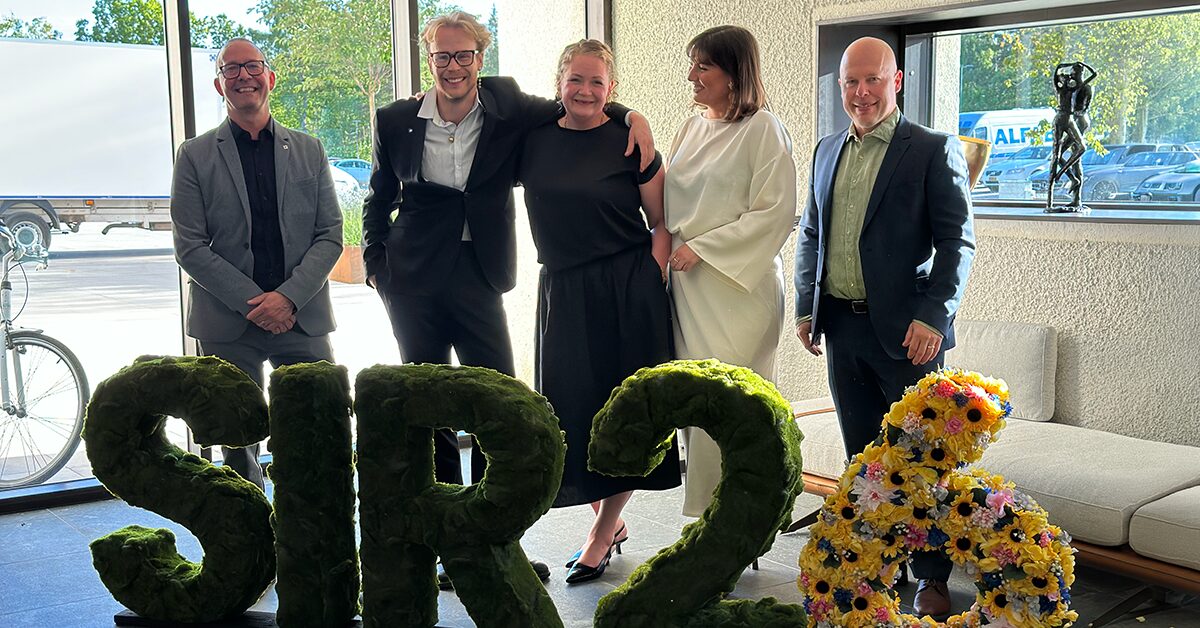
Two days. Hundreds of meetings and discussions. Perspectives from the business community, the public sector, academia, startups, and civil society.
We returned home from Sweden’s Innovation Parliament with our heads full of thoughts, but perhaps above all with one feeling: the future won’t wait for our systems to be ready.
Here are some of the insights that have stayed with us.
#1 We need to stop talking about young people and start talking to them
Some of the highlights of the program came from Right By Me, where young poets put into words their hopes for the future, their frustrations, and their longing to be taken seriously.
It served as an important reminder of who is often left out of discussions about the future. We’re happy to talk about young people as a target group, but we talk far less often with those who will actually have to live with the consequences of the decisions we make today.
It’s not just about listening to young people. It’s about letting them into the rooms where the future is discussed and decisions are made.
So it’s not about creating more initiatives for young people. It’s about creating more spaces with young people.
When 17 percent of Sweden’s young people choose not to continue their education after elementary school, the issue goes beyond the supply of skilled workers. It is about inclusion, trust, and hope for the future.
#2 We need to measure what matters to us
One of the most thought-provoking discussions during the event focused on how we measure value.
We often measure what is easy to calculate. But what is easy to measure is not always what is most important to understand.
One example that was mentioned was measuring how many girls bike to school.
It may sound like a fairly simple statistic, but it actually reveals much more than just transportation habits. If many girls bike to school, it could be a sign that they feel safe in their surroundings. That there are well-maintained bike paths and infrastructure. That children and young people have the opportunity to get around independently. That the community is designed in a way that works for more people.
Suddenly, a bike ride to school also becomes a measure of safety, equality, health, and urban planning.
Discussions about social innovation often revolved around the same question. What exactly is value? For whom are we creating value? And how do we make visible things that don’t show up on a balance sheet?
If we focus solely on economic factors, we risk overlooking things like trust, participation, security, and optimism about the future—factors that are essential to a well-functioning society.
#3 The green transition isn't on hold
At a time when so much of the conversation revolves around security, defense, and preparedness, it’s easy to get the impression that sustainability issues have taken a back seat.
But that wasn't the picture that was painted during the Innovation Parliament.
On the contrary, the sustainability perspective came up repeatedly in many discussions. The concept of “Triple Use”—innovations that strengthen defense capabilities, build resilience, and at the same time contribute to sustainable development—was mentioned several times.
It became clear that the solutions of the future need to deliver multiple benefits at the same time. The transition is not about choosing between sustainability and security. It is about building both.
The green transition hasn't been put on hold. It's continuing, but in a new context and under new conditions.
#4 Innovation is less and less about individual genius
We also heard about the Volvo Group’s work in innovation and technological development.
In the past, much of the development took place internally and behind closed doors. Today, the reality is different. Innovation is developed in collaboration with customers, suppliers, researchers, startups, and sometimes even competitors.
That says something about the times we live in.
The challenges we face are often too complex to be solved by a single organization. The ability to collaborate, share knowledge, and build relationships is therefore becoming increasingly important.
Perhaps that is also why the most important skills of the future are not just about technology. Several speakers highlighted the ability to build trust, inspire confidence, and motivate people to work toward the same goal.
#5 Sweden's competitiveness is about more than just new technology
Many of the discussions centered on Sweden's capacity for innovation and competitiveness.
How can we create faster pathways from idea to implementation? How can we ensure that new technology is developed here, and not just used here?
Several speakers noted that Sweden risks becoming increasingly adept at purchasing technology, while other countries are becoming better at developing and producing it.
This raises important questions about how we can strengthen our resilience, our capacity for innovation, our production capabilities, and our ability to translate knowledge into competitive solutions.
#6 Regional innovation capacity is becoming more important, not less
Another issue that came up repeatedly during the meeting was the EU’s cohesion policy and how future governance and resources should be allocated.
There are signs of increased centralization, both at the European and national levels. At the same time, we know that innovation does not happen within a single government agency or at a corporate headquarters.
It arises where people come together, identify problems, and develop solutions together.
For us, this raises questions about how we can ensure that local and regional innovation ecosystems continue to have the capacity to develop businesses, ideas, and communities.
Sweden's innovative strength isn't built solely in the major cities. It's built throughout the country.
#7 Either we change the systems, or the systems will change us
Perhaps the most recurring realization over the course of the days was that many of our systems were designed for a different era.
We face challenges that cannot be solved simply by streamlining what we already do. We also need to have the courage to question how these systems are designed and what behaviors they encourage.
One speaker put it perfectly:
“Either we change the system, or the system will change us.”
It’s a thought that has stayed with us.
The future isn’t just about new technology, new companies, or new innovations. It’s about our ability to bring about the necessary changes before the outside world forces them upon us.
That is also why innovation is so much more than just new products and services. At its core, it is about finding better ways to address the opportunities and challenges of the future.
A big thank you to SISP and Science Park Skövde for a wonderful few days filled with many important and inspiring discussions and presentations!